EFI and Agfa DPS: World Imaging News reviews the deal and what the implications maybe for this segment of the industry
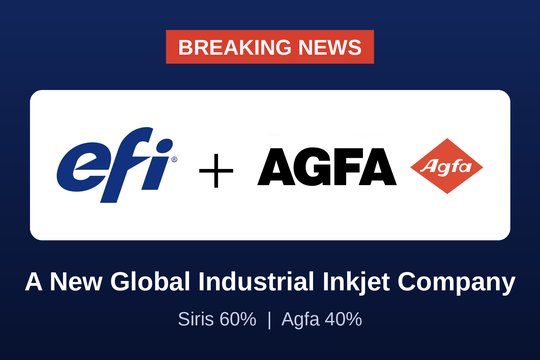
MORTSEL | Belgium and LONDONDERRY | New Hampshire – September 2026 – Electronics for Imaging (EFI) and Agfa-Gevaert (Agfa) have signed a definitive agreement to merge Agfa’s Digital Printing Solutions business (Agfa DPS) into EFI. The deal, announced September 28, 2026, is one of the largest in the print industry this year. It creates a global, full-service industrial inkjet company with about $625 million in expected 2026 revenue.
Deal Structure
An affiliate of Siris, the private equity firm that has owned EFI since 2019, will hold 60% of the new company. Agfa will keep 40%. The two will act as equal partners under a joint governance structure.
The merger covers the full scope of both businesses: printers, inks, software, workflow, and sales and service networks.
A second transaction runs alongside the merger. Siris will buy the 19.1% stake in Agfa-Gevaert held by Active Ownership, Agfa’s largest shareholder. That makes Siris both the majority owner of the new inkjet company and a major shareholder in Agfa itself.
The deal is expected to close by the end of 2026, subject to regulatory approvals, employee information and consultation processes, and customary closing conditions.
By the Numbers
- About $625 million in expected combined revenue for 2026
- About $223 million in 2025 sales for Agfa DPS
- Thousands of customers in more than 100 countries
Two Portfolios, One Company
EFI leads in several industrial inkjet markets: Nozomi in single-pass corrugated packaging, VUTEK in wide-format and Reggiani in textiles.
Agfa DPS is strong in display graphics, décor and packaging. Its recently updated lineup includes the Jeti TAURO, Onset PANTHERA and SpeedSet ORCA platforms. Industrial inkjet is now Agfa’s only remaining printing business.
Agfa’s other divisions — medical imaging, healthcare software, membranes for green hydrogen and select industrial applications — are not part of the deal. Agfa reported about $1.3 billion in total revenue in 2025.
From Partners to One Company
EFI and Agfa formed a global partnership in 2024, giving each company access to the other’s technologies to broaden its lineup. Two years later, the partners are going all the way and combining their businesses.
“Rather than continue as a standalone business, we are choosing to partner with Siris to unlock the next phase of accelerated growth for our DPS business while maintaining meaningful upside for Agfa’s stakeholders,” said Pascal Juéry, CEO of Agfa-Gevaert.
“This combination is a natural next step that allows us to build on that momentum with a broader platform, accelerating innovation and expanding the solutions we can deliver to customers across industrial inkjet,” said Frank Pennisi, CEO of EFI.
“EFI and Agfa DPS bring together distinct and complementary capabilities, forming a business with the reach and depth to do more for customers across more markets. We look forward to partnering with Agfa to accelerate innovation and expansion for customers worldwide,” said Frank Baker, Co-Founder and Managing Partner, and David Calamai, Managing Director, of Siris.
The Road to the Deal
Siris took EFI private in 2019 for about $1.7 billion. Since then, the company has sold off several businesses to focus on industrial inkjet, including its productivity software and Fiery. Seiko Epson bought Fiery in 2024 for about $591 million. In 2026, EFI’s Inèdit Software was carved out and sold to Fiery. DC Advisory advised Siris and EFI on each of these deals.
The Agfa DPS merger reverses the direction: after years of selling, EFI is now adding product lines, new markets and a larger European footprint.
DC Advisory served as exclusive financial advisor to Siris and EFI on the Agfa DPS merger. Sidley Austin LLP served as legal advisor.
Why Now: A Deal That Works for Both Owners
For Siris, time is a factor. EFI has been on Siris’s books for seven years — a long hold for private equity, where investors typically aim to exit within four to six years. The long hold comes in a market where core wide-format sales are growing slowly. Selling Fiery and Inèdit returned some capital, but a sale of EFI itself has not happened. A larger, more diversified company with a stronger packaging and European business is a more attractive asset for a future sale or public offering. Rather than an exit, the merger looks like a step toward one.
For Agfa, the deal brings room to maneuver. Agfa DPS has been a drag on Agfa’s earnings. By moving DPS into a jointly owned company, Agfa takes the business off its own books as a standalone operation, shares the cost and risk of running it, and keeps 40% of any future upside. That frees Agfa’s management and capital to focus on its healthcare and green hydrogen businesses — without giving up on digital printing entirely.
Market Impacts on Wide-Format and Industrial Inkjet
A shift in wide-format leadership. VUTEK, Jeti and Onset have competed head to head for years in high-end roll-to-roll, hybrid and flatbed sign and display printing. Under one roof, the combined company becomes one of the largest suppliers in this segment.
Product-line overlap. Wide-format is where the two lineups overlap most. How the company will align competing platforms is still an open question, and print service providers will want answers on roadmaps, upgrades and long-term support.
A stronger packaging play. Nozomi and SpeedSet ORCA give the new company two single-pass platforms for corrugated and folding carton. Packaging is one of the fastest-growing areas in industrial inkjet, and the combination creates one of the broadest digital packaging portfolios in the market.
A bigger European footprint. EFI has been strongest in North America and Agfa in Europe. Together, the company has sales and service coverage on both sides of the Atlantic.
Ink and service scale. Both companies build much of their business on inks and service. A combined global service network and ink portfolio gives the company more scale, and customers will watch for changes in service coverage, ink pricing and supply.
Channel questions. Dealers and distributors that carry only one of the two brands may see their territories and product lines change as the company integrates.
What It Means for Competitors
The new EFI changes the competitive map across wide-format, packaging and textiles. Each rival faces a different challenge.
Durst and Vanguard. Durst competes with EFI and Agfa at the high end of wide-format, in single-pass packaging and in textiles, while Vanguard covers the value end of UV flatbed and roll-to-roll printing. Durst is family-owned and has built its business on a full portfolio of printers, inks and software. It now faces a rival with similar breadth and more scale. Its advantages are speed, independence and long-term customer relationships — with no integration to manage.
swissQprint. The Swiss maker built its name on precise, reliable flatbeds for the midrange market. It competes most directly with Agfa’s Jeti TAURO and Anapurna customers and with EFI’s hybrid and flatbed VUTEK models. If the combined company merges or trims those lines, swissQprint could win buyers looking for a stable, focused alternative.
HP and Canon. Both global groups have deep resources and wide reach. HP leads in latex wide-format and PageWide packaging, and Canon has its Arizona flatbeds and Colorado roll-to-roll printers. For them, the new EFI is a stronger specialist competitor, especially in high-volume industrial inkjet.
Epson, Mimaki and Roland DG. These companies are strongest in entry-level and midrange wide-format, sign and textile printing, where EFI and Agfa play less. The direct impact is smaller, but a larger EFI with a broader ink and service network could push further into the midrange.
Packaging and textile specialists. In corrugated and folding carton, BOBST, HP, Koenig & Bauer and Screen now face two single-pass platforms under one company. In textiles, Reggiani competes with Kornit, MS Printing, Durst and Epson.
Chinese manufacturers. Makers such as Handtop and others continue to push on price in UV and wide-format. Scale helps the new EFI compete on cost, but pricing pressure from Asia remains one of the main forces in this market.
Will Consolidation Continue?
WIN’s view: yes. The forces behind this deal are affecting the whole market.
Rising R&D costs. Printheads, inks, software and automation take heavy investment, and scale makes it easier to spread those costs.
Slower equipment cycles. Capital equipment sales in wide-format are more mature, and growth now comes from packaging, textiles and industrial applications. Companies need broader portfolios to reach those markets.
Ink as the profit engine. Most of the long-term profit comes from inks and service. A larger installed base means more recurring revenue, which makes consolidation attractive.
Private equity pressure. Private equity now owns or backs several major printer makers. These investors need exits, and mergers are a common path to one.
Price pressure from Asia. Lower-cost Chinese manufacturers are forcing Western makers to cut costs and add scale.
Midsize, independent and family-owned makers — especially those with succession questions or narrow product lines — are the most likely targets or merger partners. Larger groups with weak positions in packaging or textiles may also look to buy. For print service providers, the practical question is the same one raised by this deal: what happens to your platform, your ink supply and your service contract when the company behind them changes.

 French
  English