
WIN REPORT
The latest edition of the WIN REPORT offers a comprehensive, vendor-neutral analysis of the rapidly evolving Direct-to-Film (DTF) ecosystem. From entry-level shop setups to high-volume commercial production lines, DTF technology has shifted from a niche alternative to a dominant force in modern textile and apparel decoration.
The WIN REPORT highlights how industry trends are shaping the future of DTF technology.
This report breaks down critical technology shifts, essential buyer criteria, and real-world machinery specs to help you navigate your next equipment investment.
By following the insights in the WIN REPORT, businesses can make informed decisions when investing in DTF equipment.
10 Trends Defining the Next Phase of Direct-to-Film Printing
According to David Sweetnam, Director of Lab Services at Keypoint Intelligence, DTF technology is advancing beyond basic hardware into fully integrated production ecosystems.
The WIN REPORT emphasizes the importance of automation in modern DTF production.
Powderless DTF Systems: Innovations like Nur Inks’ powder-free technology eliminate hot-melt adhesive powders for cleaner workflows and softer transfers.
Essential Automation: Labor shortages continue to drive investments in automated film handling, curing, inline cutting, and garment loading.
AI-Powered Quality Control: Real-time vision systems monitor nozzle failures, banding, and color drift to prevent wasted media.
Software-Driven Productivity: Workflow automation, cloud monitoring, and high-performance RIP software are becoming primary purchasing factors.
With the guidance provided in the WIN REPORT, companies can enhance their productivity and efficiency.
Creative Differentiation: Expanded color sets (CMYKOG+W), fluorescent inks, and specialty films help print providers stand out in a commoditized market.
In the WIN REPORT, unique strategies for creative differentiation are presented to help businesses stand out.
Focus on Reliable Supplies: High-volume operators prioritize batch consistency and supplier support over chasing cheap, unverified inks.
As highlighted in the WIN REPORT, focusing on reliable supplies is crucial for DTF success.
Sustainability Requirements: Customer demand and regulations favor low-energy curing systems, reduced waste, and eco-certified consumables.
The sustainability requirements outlined in the WIN REPORT are shaping industry standards.
Expanding Application Horizons: Beyond standard t-shirts, DTF expands into footwear, workwear, bags, and hard promotional goods.
According to the WIN REPORT, expanding application horizons is key to staying competitive.
Smart Factory Integration: Live production dashboards, predictive maintenance, and remote tracking push operations closer to “lights-out” manufacturing.
Ecosystem Solutions: Single-source ecosystems combining hardware, software, inks, and dedicated service replace piecemeal component buying.
Key Buyer Considerations: Who Really Built Your DTF Printer?
Understanding the insights from the WIN REPORT can clarify buyer considerations in DTF printers.
Industry expert Kjell Karlsson of Printing TLDR highlights that many entry-to-mid-range DTF printers share identical underlying chassis and Epson printheads. When evaluating equipment, brand badges tell only part of the story.
Four Critical Questions Before Investing:
Hardware & Component Sourcing: Who manufactures the printhead and control board (e.g., Hosonsoft vs. BYHX), and what is the exact spare-part lead time?
The WIN REPORT provides essential knowledge about hardware sourcing.
Ink Architecture Economics: Is the ink system open (third-party bottled) or closed (certified OEM), and what is the total cost over a full year of production?
Long-Term Support: Who provides technical service, parts, and warranty coverage if reseller relationships shift?
Software Integration: Which RIP software platform drives the unit, and does it support required workflow automation tools?
Featured Direct-to-Film Products & Systems
According to the latest WIN REPORT, featured DTF products are revolutionizing the industry.
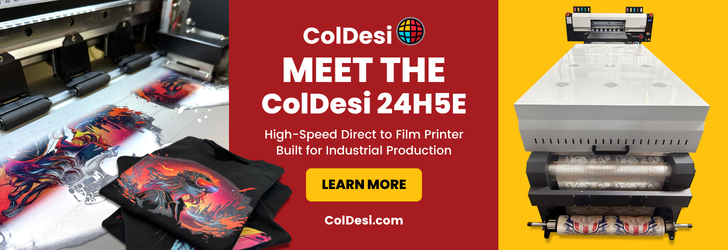
ColDesi DTF 24H5E
Overview: A high-speed 24-inch system engineered for scalable, high-volume apparel decorators.
Key Features: Uses five Epson i3200 printheads delivering up to 275+ linear feet per hour. Features an automated wet capping system to prevent clogs and a dancer bar system for precise film tension. Includes an expanded gamut (CMYKOG+W) option.
DTFLINE HYBRID-X2
Overview: A dual-purpose commercial platform providing both DTG and DTF printing capability on one unit.
The WIN REPORT details the overview of the DTFLINE HYBRID-X2.
Key Features: Powered by four Ricoh piezo-electric printheads running up to $1200\times1200\text{ dpi}$. Features automatic white ink circulation, closed-loop ink delivery, and streamlined software mode switching.
Epson SureColor G9070
Overview: A 64-inch industrial production printer engineered for uninterrupted, twin-roll film processing.
For more insights, refer to the WIN REPORT for a comprehensive analysis.
Key Features: Incorporates user-replaceable PrecisionCore Micro TFP printheads reaching speeds up to $350\text{ ft}^2/\text{hr}$. Features Auto Nozzle Compensation, automated suction cap cleaning, and bulk sealed ink packs.
Crio 8432WDT
Overview: A compact, powderless DTF+ white toner desktop printer for low-volume and custom transfer applications.
Key Features: Single-pass CMYK or White printing on media up to $11.6\times52\text{ inches}$. Employs a self-weeding process that requires no manual weeding, cutting, or liquid powder handling.
Mimaki TxF300-75
Key features of the Mimaki TxF300-75 are elaborated upon in the WIN REPORT.
Overview: A 31.5-inch professional-grade DTF printer built on Mimaki’s industrial hardware engine.
Key Features: Dual piezo heads with MCT Version2 white ink circulation. Features built-in Nozzle Check Units (NCU) and Nozzle Recovery Systems (NRS) for automated defect recovery alongside OEKO-TEX certified PHT50 inks.
Polyprint FilmJet Mini DTF
Overview: An all-in-one compact chassis combining printing, powder application, and curing in a single footprint.
Key Features: Equipped with dual Epson i1600 or i3200 heads, an integrated Mini PC, built-in air purification, active wet-capping, and mobile file transfer capabilities.
Roland DG TY-300i
Overview: A 30-inch commercial DTF printer engineered for reliable, production-ready output.
Key Features: Features four dedicated white ink channels supporting mid-run pouch replacement, speeds up to $188.2\text{ sq ft/hr}$, and full integration with VersaWorks RIP and Roland DG Connect.
STS Inks XPD-924D + S24 Shaker Bundle
The STS Inks XPD-924D product features discussed in the WIN REPORT showcase advanced capabilities.
Overview: A turnkey 24-inch print-to-cure solution combining a dual-head printer with an automated TPU shaker/dryer.
Key Features: Staggered AccuFine HD heads delivering $188\text{ sq ft/hr}$, automated feed alignments (DropMaster 2), top/bottom infrared drying, and an integrated HEPA purifier.
SuperGamut Kraken & Sentinel System
Overview: A high-throughput 32-inch production setup paired with a vision-guided laser cutter.
Key Features: The Kraken uses eight Epson i3200 heads, a magnetic dual-rail drive, and a 9-color gamut (CMYKRGBO+ Super Blue). The Sentinel cutter utilizes overhead HD cameras and dual $\text{CO}_2$ lasers to cut transfers in under 3 seconds without cut files.
UNINET DTF Xpress
The advantages of the UNINET DTF Xpress are detailed in the WIN REPORT.
Overview: An integrated 17-inch DTF platform featuring a built-in shaker, four-zone heater, and onboard curing oven.
Key Features: Eight industrial printheads, internal HEPA filtration eliminating external venting needs, sealed ink/powder systems, and standard 110V operation.
Frequently Asked Questions (FAQ)
In the WIN REPORT, readers can find answers to frequently asked questions about the DTF process.
What is the main advantage of powderless DTF technology?
Powderless DTF eliminates hot-melt adhesive TPU powder from the production process. This creates a cleaner shop environment, reduces processing steps, lowers consumable overhead, and provides finished garments with a significantly softer hand-feel.
Why are control boards as important as printheads in DTF printers?
While over 70% of DTF printers utilize Epson printheads, the control board governs signal timing, motion accuracy, and dead-nozzle compensation. Production-grade boards like BYHX deliver higher signal stability at fast speeds compared to basic entry-level control boards.
What environmental conditions are required to operate DTF equipment reliably?
Most commercial DTF printers and shakers require climate-controlled environments kept between 65°F–80°F (18°C–27°C) with non-condensing relative humidity between 40%–70%. Stable humidity prevents white ink sedimentation, nozzle clogging, and static build-up on PET media.
How do expanded color gamuts benefit DTF print production?
Adding extra ink channels—such as Orange, Green, Red, or Super Blue—allows print shops to accurately reproduce challenging brand spot colors and achieve deeper saturation that standard CMYK configurations cannot match.
Download Full WIN REPORT Here
For a deeper understanding, download the full WIN REPORT for comprehensive coverage.

 English
  French