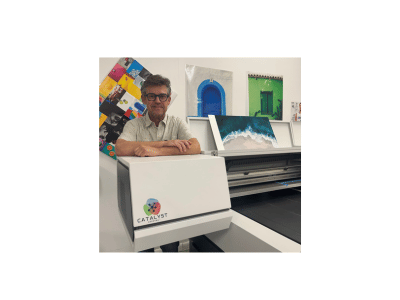
According to Lon Riley, Founder of DPI Laboratory, “In UV printing, the real margin losses often happen between steps, not at the printhead.”
ST. PETERSBURG | Florida – April 2026 – Most conversations still start with print size, speed, ink configuration, or the quality of a sample pulled at a trade show. Those things matter, but they do not decide whether a UV printer will actually make money in daily production. The real test starts once the machine is part of the workday. Can your team run it without rebuilding settings from memory? Can repeat jobs move cleanly from order to print to finishing? Can the operator keep things moving without babysitting the machine all day? Can the business grow without adding a mess of extra steps?
That is why workflow design matters more now. Shops are not just buying output anymore. They are buying a system that has to hold up under pressure, repeat cleanly, and protect margin when the day gets busy. Here are five reasons workflow design deserves a lot more attention in UV printing.
Hidden Time Is Where Profit Starts Leaking
The biggest losses in UV printing usually do not come from dramatic machine failures. They come from the smaller workflow gaps that pile up all day. A file needs cleanup before print. A job gets set up again because the last version was not saved correctly. Someone has to hunt for the right profile. A print gets rerun because a setting changed between shifts. A finished piece sits too long because nobody has clear job visibility.
None of this looks like a major problem on its own, but over a week or a month, it quietly eats margin. Good workflow design cuts down those wasted motions and gives the team a cleaner path from intake to output.
Repeatability Matters More Than Speed Claims
A fast printer that produces inconsistent results creates its own slowdown. When output changes from one operator to another, or from one day to the next, the shop starts paying for it in remakes, delays, wasted material, and frustrated customers. The problem is not just print quality. It is unpredictability.
That is where workflow design becomes critical. A strong workflow makes jobs easier to repeat because settings, layouts, files, and production steps are easier to save, recall, and route correctly. It supports consistency instead of forcing the shop to rely on memory or operator improvisation. In real production, repeatability protects revenue. A printer that can do the same job the same way every time is worth a lot more than one that only looks good during a demo.
Automation Is Only Useful If the System Behaves
A lot of people talk about automation as if it begins and ends with software. It does not. Automation only works when the full system behaves predictably, including the hardware, the workflow logic, the file handling, the job routing, and the operator steps around the machine.
If the printer needs constant manual intervention, if maintenance routines are inconsistent, or if the software does not support clean job recall, automation starts to fall apart. At that point, the shop is not reducing friction. It is building workarounds. Good workflow design starts with the real conditions of production and makes sure jobs can move through the system with fewer surprises, fewer corrections, and fewer chances to go sideways.
A Good Printer Cannot Fix a Broken Process
One of the biggest workflow problems in UV printing is fragmentation. The order comes in through one channel, artwork gets handled somewhere else, print files get prepared in another step, production status is tracked loosely, shipping lives in its own process, and quality control may or may not tie back to the original job. At that point, even a good printer is stuck inside a broken system.
That is why more shops are thinking beyond the machine itself. They do not just need a printer. They need the steps around the printer to connect. The goal is not to replace every tool in the business. It is to reduce the disconnects between them. When order intake, file preparation, print routing, production visibility, and fulfillment work together, the shop gets easier to manage and a lot easier to scale.
Better Workflow Makes Growth Less Chaotic
As production grows, complexity grows with it. More SKUs, more short runs, more versioning, more mixed materials, more custom work, and more pressure to move quickly with a smaller team all put stress on the system. That is why workflow design matters even more over time. A process that feels manageable at low volume can get chaotic fast once more products and orders hit the floor. What worked when one experienced operator handled everything usually starts to break once the business adds staff, equipment, and more job variety.
The answer is not always more labor. A lot of the time, the smarter move is better workflow. The strongest UV production environments are built around simplicity, visibility, and repeatability. They take guesswork out where they can and let operators focus on quality instead of spending the day fixing process issues.
The Bottom Line
A lot of UV shops do not really have a print problem. They have a handoff problem. That is why workflow design is no longer a secondary issue or something you bolt on later. It is part of whether a UV system is actually usable, scalable, and profitable in the real world. If UV printing is going to keep moving forward, the next real advantage will not come from specs alone. It will come from systems that help shops run with less friction, more consistency, and a lot less wasted motion.

 English
  French