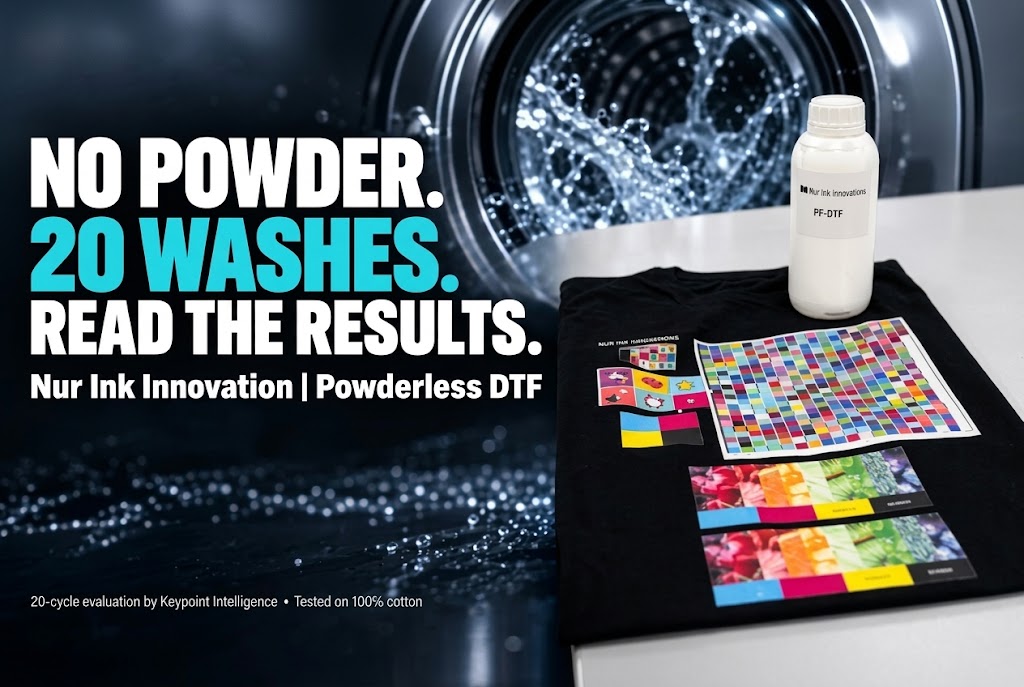
Nur Ink’s powderless DTF moves beyond trade-show promises with wash-test results from Keypoint Intelligence. Read full report below.
ROSH HA’AYIN | Israel – October 2026 – A great-looking transfer gets attention. A great-looking transfer after repeated washing earns confidence.
For powderless direct-to-film printing, that distinction matters. Removing adhesive powder is an appealing idea—but decorators still need to know whether the print will hold up.
A September 2026 report from Keypoint Intelligence, commissioned by Nur Ink Innovation, puts that question to the test. Under the conditions evaluated, Nur’s powderless DTF solution completed 20 wash-and-dry cycles without visible print breakup or reduced stretch resistance.
The adhesive is in the ink
Rather than applying separate adhesive powder, Nur’s solution uses two white inks with adhesive properties. Together, they bond the color image to the fabric.
The evaluation used a LEAF LF-740A printer, MaxDTF film, and white and black Next Level 3600 shirts made from 100% cotton. Garments were washed inside out at 30°C, then either air-dried or tumble-dried between washes.
The test examined more than fading. It tracked text legibility, graphic quality, stretch resistance, color stability, and color gamut.
Small details survived
After 20 cycles, 8-point text remained legible on both white and black shirts, with the highest rating across both drying methods.
That matters for artwork with fine lettering and small details. A bold logo may hide deterioration; tiny text gives it fewer places to hide.
Halftone and vector graphics also received the highest rating throughout testing, with no observed degradation. Stretch resistance earned the same rating after 10 and 20 cycles for both drying methods.
Color held—but the results weren’t identical
At 20 washes, average measured color differences ranged from 1.3 to 1.6 DeltaE00 across the four shirt-and-drying combinations. That measurement tracks how much color changes from the original print.
The range of reproducible colors also narrowed in some conditions:
| After 20 washes | Air-dried | Tumble-dried |
|---|---|---|
| White shirts | 0% gamut shrinkage | 3% |
| Black shirts | 1% gamut shrinkage | 10% |
The largest reduction occurred on tumble-dried black shirts. That deserves attention alongside the strong visual durability results: different measurements can reveal different aspects of print performance.
Read the results—and the setup
These findings support the wash durability of the tested combination. They don’t establish performance on every fabric, printer, or production setup, or beyond 20 cycles.
The process also included two heat-press steps: 55 seconds at 170°C, followed by another 10 seconds at the same temperature. Nur recommended a printhead check every 20 minutes of continuous printing.
Those details belong in any production evaluation. Powderless printing still needs a dependable curing, transfer, and maintenance process.
Keypoint Intelligence also cautions against comparing these results directly with AATCC or other wash-test claims that use different protocols.
A reason to take a closer look
This report gives decorators a concrete reason to investigate Nur’s powderless approach: 20 tested cycles, readable fine text, intact graphics, and retained stretch resistance.
The next step is to test it with your artwork, garments, and production requirements—and measure the workflow as carefully as the finished print.
The powder is gone. In this evaluation, the print held on.

 English
  French