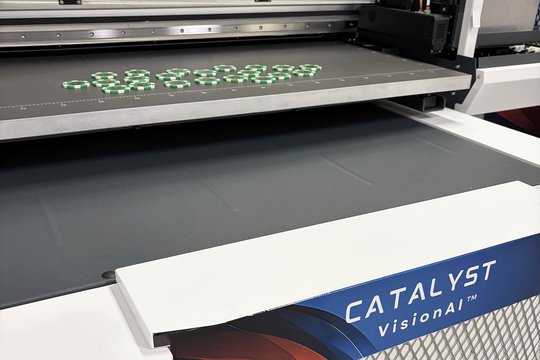
ST. PETERSBURG | Florida – July 2026 — Small-format UV printing has opened real opportunities for print shops, promotional product companies, awards businesses, packaging teams, and custom product decorators — but as DPI Laboratory’s Lon Riley notes, the print itself is only part of the job. Much of the time and frustration happens before the print starts. With Catalyst VisionAI, integrated into the company’s Catalyst Aventra and Catalyst Nexus platforms, DPI Laboratory is addressing the industry’s long dependence on jigs, fixtures, and templates with a vision-guided workflow that reads item placement and adjusts print positioning automatically.
The Problem: Fixture-First Workflows Slow Modern Shops Down
For years, small-format UV printing has depended on jigs, fixtures, and tightly controlled item placement. That approach has its place — for shops printing the same product in the same position repeatedly, a jig creates repeatability. But many shops don’t work in that predictable environment. They handle short runs, custom orders, mixed products, prototypes, and last-minute client requests that change throughout the day.
In that environment, a fixture-first workflow slows production. An operator may need to build or select a jig, place each item in a fixed position, align artwork to the template, test print position, and repeat the process for the next product. “For repeat work, that may be acceptable,” says Riley. “For high-mix, low-volume production, the setup can take longer than the print itself.”
The Solution: Catalyst VisionAI
On the Catalyst Aventra and Catalyst Nexus platforms, the integrated Catalyst VisionAI system uses visual data from the bed to understand where items are positioned and adapt the print accordingly — no fixed fixture or perfectly repeated manual placement required.
The system does not remove the need for a skilled operator. File prep, product knowledge, and material behavior still matter. The difference is that the printer reduces the friction between the operator, the artwork, and the object being printed. With a vision-guided workflow, the bed becomes part of the production data: item location, artwork position, layout, and setup time all become part of how the job moves through the system.
More Room to Say Yes
Jigless printing gives shops flexibility to take on varied work: a promotional products company decorating several different items in one production window, an awards shop handling irregular shapes and one-off personalization, a packaging team testing prototypes quickly, or a boutique manufacturer marking parts without building a dedicated fixture for every variation.
“The issue is not that jigs are bad,” Riley explains. “The issue is that modern shops need options. They need repeatability when the job calls for it, but they also need flexibility when the work changes.”
Protecting the Investment
The workflow question is especially important for shops adding UV printing as a new revenue stream. When a business invests in a printer, it is buying a workflow, not just hardware. If that workflow demands too much trial and error or fixture building, the machine becomes harder to use than expected — while a smarter workflow gets the shop productive faster and protects the investment over time.
“The bigger question is what happens in daily production,” says Riley. “How long does it take to get a job ready? How quickly can the shop move from one product to another? How much time is lost before the printer starts producing sellable work? Those are the questions that affect profit.”
A More Adaptive Production Model
The shift from jig-dependent to vision-guided production gives print providers more control over their time and workflow. For shops dealing with short runs, custom products, mixed batches, and fast turnarounds, that difference can change what they produce, how quickly they produce it, and how confidently they grow.
Small-format UV printing does not need to stay locked into the old setup model. The next step is a printer that can see the job, understand the placement, and help the operator get to production faster.

 English
  French